
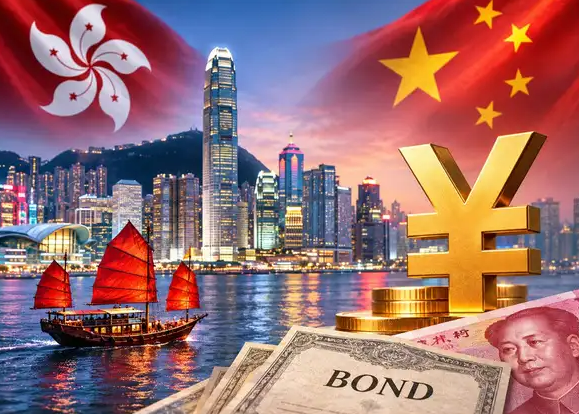
Hong Kong Strengthens Its Role in Global Finance With a New Offshore Yuan Bond Index
28 November 2026
Hong Kong’s first dedicated benchmark for offshore renminbi bonds is designed to make the dim sum market more visible and investable. Its long-term impact will depend on liquidity, issuer diversity and the products that asset managers build around it.

immigrationcases.org/
A benchmark for a growing offshore yuan market
Hong Kong has taken another step in its effort to strengthen its position as a global financial centre and the leading offshore hub for renminbi business. Hong Kong Exchanges and Clearing Limited (HKEX) launched the HKEX Offshore RMB Bond Index on 16 November 2026, introducing the first HKEX-branded fixed-income index and the city’s first benchmark dedicated to dim sum bonds issued in Hong Kong.
Dim sum bonds are renminbi-denominated debt securities issued outside mainland China. They connect borrowers seeking yuan funding with investors who want exposure to yuan assets without buying onshore mainland bonds. The market has expanded as Chinese and international companies, financial institutions and public-sector issuers have looked to diversify funding sources and investor bases.
The new index is intended to provide a transparent reference for the performance of eligible offshore RMB bonds. HKEX is working with Bloomberg Indices, whose index services business will act as administrator and calculation agent. The partnership also envisages a broader co-branded index suite that could support passive and active investment strategies, benchmarking and market analysis. HKEX’s announcement sets out the launch and the collaboration.
What the new index measures
The index covers eligible offshore renminbi-denominated Treasury, government-related and corporate debt securities. To qualify, securities must be listed on the Stock Exchange of Hong Kong and/or lodged with the Central Moneymarkets Unit (CMU), Hong Kong’s debt securities custody, clearing and settlement infrastructure. This design ties the benchmark to the city’s existing market infrastructure rather than attempting to represent every offshore yuan bond issued worldwide.
HKEX describes the index as a total-return benchmark denominated in CNH, the offshore renminbi. Its published parameters include a base date of 31 August 2021 and a base value of 100. Eligible bonds must be fixed-rate, have at least CNH 1 billion outstanding and retain at least one year to final maturity. The index is updated daily and rebalanced monthly. These rules give investors a consistent framework for comparing performance, although the quality of any benchmark ultimately depends on the breadth and liquidity of the securities it contains. The official index page provides the methodology and current specifications.
According to HKEX, offshore RMB bond issuance exceeded RMB 590 billion in the first nine months of 2026, excluding certificates of deposit. The exchange also said Hong Kong has accounted for more than half of exchange-listed offshore RMB bonds globally since 2024. Those figures point to a sizeable issuance base, but issuance volume alone does not guarantee active secondary trading. A benchmark can help investors monitor the market; it cannot, by itself, ensure that bonds trade frequently or at tight bid-ask spreads.
Why a recognised benchmark matters
Bond markets rely on reference points. A well-constructed index can help investors assess returns, compare managers, evaluate risk and communicate an investment strategy. For a market that is still developing its international investor base, a recognisable benchmark may also reduce the research burden faced by institutions that do not follow individual dim sum issues closely.
The index could be particularly useful for asset managers considering exchange-traded funds (ETFs), index funds and other portfolios linked to offshore yuan debt. HKEX has said that a number of asset managers are working with Bloomberg on potential products based on the new indices. Such products would give investors a packaged route into a diversified basket of bonds, rather than requiring them to select individual securities and manage custody and settlement arrangements themselves.
RTHK reported that the benchmark initially tracks more than 300 offshore renminbi bonds listed in Hong Kong. Hong Kong’s Financial Secretary Paul Chan presented the launch as a reference point for market performance and a foundation for index-linked products. He argued that broader participation could support secondary-market trading, improve price discovery and potentially lower transaction costs. These are plausible channels, not guaranteed outcomes: ETF demand will translate into deeper liquidity only if underlying bonds can be traded efficiently and market makers are willing to provide continuous pricing. RTHK’s report summarises the launch and the government’s expectations.
Hong Kong’s wider offshore RMB strategy
The index fits into a broader policy effort to deepen Hong Kong’s offshore renminbi ecosystem. The city offers international investors access to yuan-denominated assets while maintaining financial and legal arrangements distinct from those on the mainland. Its role is supported by banks, bond arrangers, clearing and settlement systems, asset managers and links to mainland markets.
Hong Kong’s 2026 Policy Address set out plans to expand dim sum bond issuance, improve the tenor structure of the market, support development of an offshore yuan yield curve and encourage the use of bonds as collateral. It also identified the HKEX index as a reference for market trends and a potential underlying benchmark for ETFs. Separately, the government cited offshore RMB lending of RMB 935 billion in 2025 and bond issuance reaching RMB 1 trillion for two consecutive years. Those policy priorities place the index within a wider programme rather than treating it as a stand-alone product. The Policy Address details the measures.
For Hong Kong, the strategic objective is not simply to host more bond listings. It is to capture a larger share of the services surrounding capital markets: arranging and distributing debt, providing custody and settlement, managing assets, pricing risk and developing hedging instruments. A benchmark can strengthen this ecosystem by making the underlying market easier to analyse and by giving product providers a common reference.
Internationalisation, but not a one-way bet
The offshore yuan market is closely connected to China’s gradual efforts to increase the currency’s international use. Offshore bonds allow overseas borrowers to raise renminbi and give global investors access to yuan-denominated fixed income. This can broaden the currency’s role beyond trade settlement into funding and investment. RTHK quoted Chan as noting that overseas governments, companies and multilateral development institutions have used Hong Kong to raise renminbi, illustrating the currency’s potential as a funding unit as well as an investment asset.
However, the internationalisation of the renminbi is not a linear process. Demand for offshore yuan assets is affected by expectations for China’s economic growth, interest-rate differentials, currency volatility, capital-market access and confidence in the convertibility and use of the currency. Investors also compare dim sum bonds with US-dollar, euro and other local-currency alternatives. A benchmark makes performance easier to measure, but it does not remove foreign-exchange risk or guarantee that investors can exit positions at the desired price.
Market structure also matters. If index constituents are concentrated among a small group of issuers or maturities, the benchmark may offer less diversification than its headline bond count suggests. Monthly rebalancing and daily index calculation create a disciplined framework, but fund managers will still need to consider constituent liquidity, credit quality, duration, concentration and the costs of tracking the index.
What investors and issuers should watch next
The next test is whether the index leads to actual products and more consistent secondary-market activity. Investors will want to see transparent methodology, reliable pricing, clear disclosure of constituents and costs, and sufficient trading depth in the bonds held by index-tracking funds. Asset managers will need to assess whether ETF creation and redemption can be conducted efficiently, particularly during periods of market stress.
Issuers may benefit if a larger investor base makes Hong Kong a more attractive venue for renminbi borrowing. A stronger benchmark ecosystem could improve visibility for new issues and help investors compare credit and yield across government-related and corporate borrowers. Yet funding costs will continue to depend on issuer creditworthiness, market conditions, currency expectations and the supply of competing bonds. The existence of an index does not automatically reduce borrowing costs.
HKEX’s collaboration with Bloomberg gives the initiative an established index-administration partner and a potential route to international distribution. The exchange has also identified a group of asset managers exploring products linked to the benchmark. The scale, structure and launch timing of any resulting funds will be important indicators of whether the index is becoming an investable market reference or remains primarily a market-development signal. The South China Morning Post reported that the benchmark covers 305 bonds valued at about US$42 billion as of 30 October 2026, offering an indication of the market universe at launch.
A step forward, not an instant transformation
Hong Kong’s new offshore RMB Bond Index is a practical piece of financial-market infrastructure. It gives dim sum bonds a dedicated benchmark, links the market more closely to international index practices and creates a potential foundation for ETFs and other investment products. These functions could help make offshore yuan assets easier to analyse, distribute and include in diversified portfolios.
But the index’s success will be measured by what follows: sustained investor demand, a broader range of issuers, active secondary trading, competitive product costs and resilient market liquidity. Hong Kong already has a strong position in offshore renminbi finance. The new benchmark is an attempt to turn that position into a deeper and more accessible fixed-income ecosystem. Whether it does so will depend less on the launch announcement than on the market activity built around it in the years ahead.
Next article :
– Global Health Systems Face New Challenges From Emerging Infectious Diseases
– Global Supply Chains Are Being Rebuilt Around Economic Security Rather Than Low Costs
– Ukraine’s Reconstruction Could Become One of Europe’s Biggest Investment Challenges